Scientific evidence guide
Facial Estrogen Research: Connecting the Tested Cream to the Claim
A close reading of formulation identity, measurement scales and the difference between a study result and a product promise.
Published October 22, 2026 · Updated October 22, 2026 · Sources checked October 21, 2026
Public-source editorial review. No clinician sign-off, firsthand product testing or personal assessment claimed.
A facial-cream claim should connect an identifiable preparation to a clearly defined outcome. That sounds straightforward until a hormone name stands in for a complete formula, a rating becomes a percentage of rejuvenation, or a laboratory comparison becomes a promise about safety. Each substitution changes the question the evidence is being asked to answer.
This analysis approaches the facial estrogen pilot as a sequence of scientific decisions: what was compared, what the measurements represent, how uncertainty should be handled, and what would be needed to connect the research to a product listing. The numerical examples below are explicitly hypothetical teaching examples. They explain interpretation without supplying missing trial results or a recommendation to use a hormonal preparation.
In this reading
Study figure and data
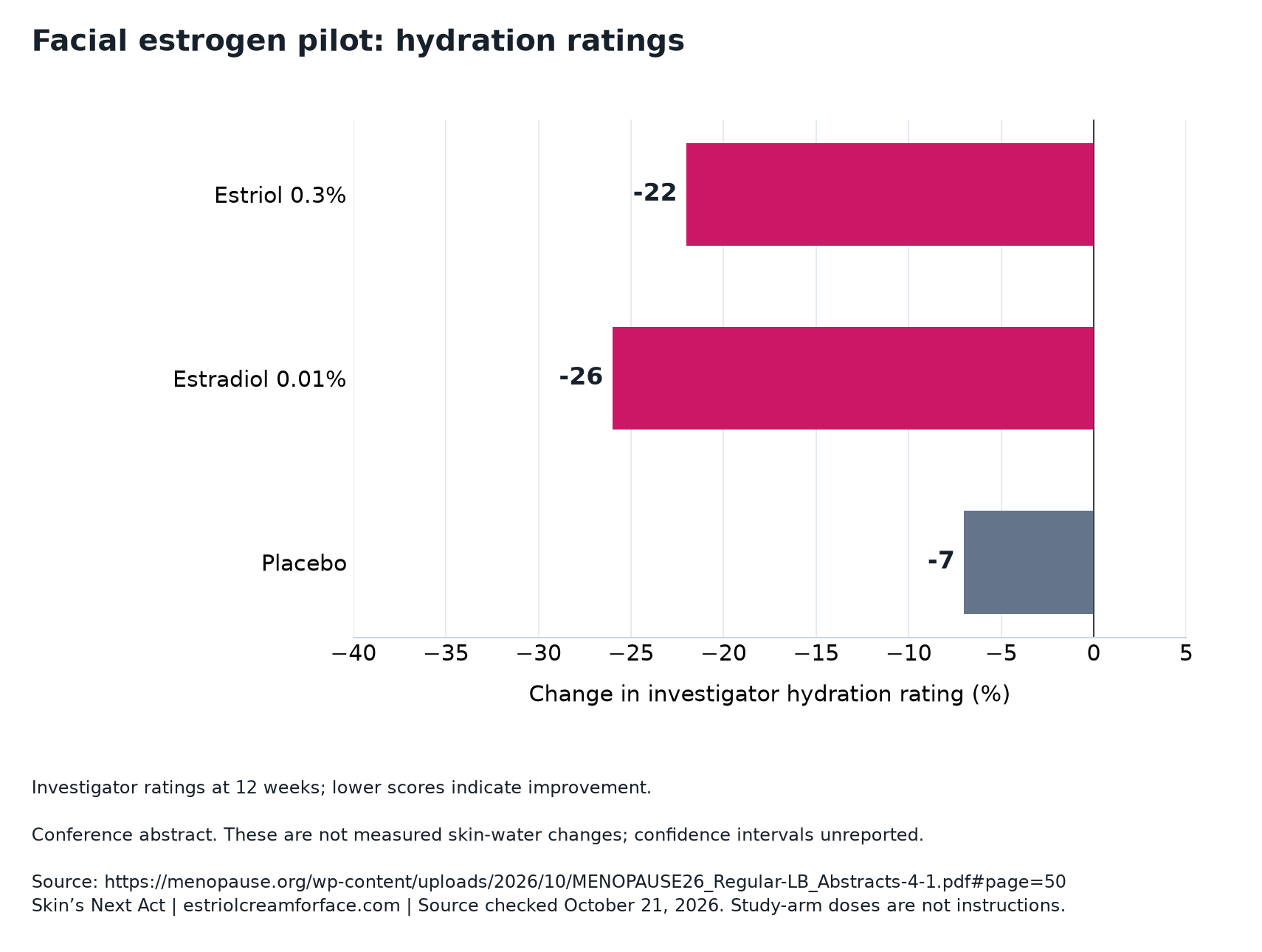
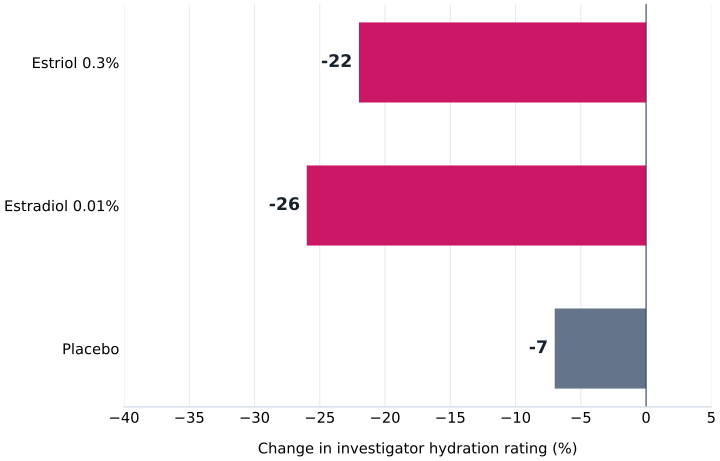
Facial estrogen pilot: hydration ratings
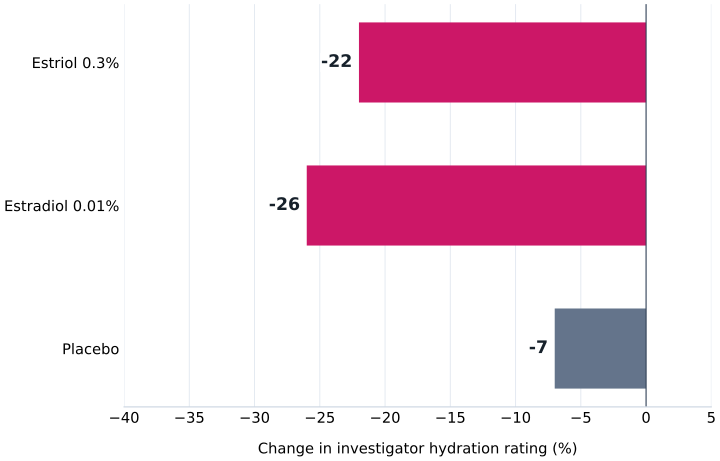
Investigator ratings at 12 weeks; lower scores indicate improvement.
Conference abstract. These are not measured skin-water changes; confidence intervals unreported.
Download chart (PNG)Download data (CSV)Download vector chart (SVG)
| Study group | Reported value |
|---|---|
| Estriol 0.3% | -22 |
| Estradiol 0.01% | -26 |
| Placebo | -7 |
Start with the trial record, then define the claim
The 2026 conference pilot randomized 90 postmenopausal women aged 50–60, 30/arm; 86 completed 12 weeks. Blinded cream comparisons used placebo. Primary outcomes were investigator ratings on 0–4 scales. Fine-line/wrinkle comparisons were nonsignificant, as were participant-efficacy and between-group serum comparisons. Estriol firmness: table P=.077 conflicts with the narrative. No tolerability issues were reported on the assessment scales. Alloy Health funded it; retail-product identity is unestablished. Confidence intervals and multiplicity details are unreported.
Our interpretation begins by separating three questions: whether the assigned preparations produced different measured changes, whether a person would value those changes, and whether a product being considered is the tested preparation. Evidence that answers the first question does not automatically answer the other two. The distinction matters before selecting a result for a headline, because an attractive endpoint can become a substitute for the outcome a reader actually wants.
Write the desired claim first, then identify the measurement that would support it. For a claim about visibly fewer wrinkles, specify how visible change would be judged, against what comparison, and at what time. For a claim about comfort, specify whose judgment counts. This turns a broad promise about skin into a question that an experiment could resolve.
Match the tested cream to an identifiable formulation
Consider formulation identity as an evidence chain: the research preparation, its manufacturing record, the material dispensed, and the product listing need a documented connection. A shared ingredient name fills only one link. To assess that connection, a reader would want the chemical identity, concentration, vehicle, accompanying ingredients, preparation specifications and evidence of what was actually dispensed. This is a proposed documentary standard, not a claim that any named seller has failed a quality test.
Concentration alone cannot establish that two preparations reproduce the same exposure. Even before considering biology, there are unanswered documentary questions: does the percentage use the same convention, is the description current, and does the label describe the complete formula or only one highlighted ingredient? The guide to estriol terminology provides a separate place to examine the hormone name without treating that name as a clinical result.
For this research question, product matching should precede outcome matching. If the connection is uncertain, the defensible statement concerns the studied preparation. A commercial formulation would need its own connecting evidence. That sequence avoids silently replacing a research material with a product whose composition is described differently.
Ask what the rating scale is measuring
A rating assigns a category or score to an observation. Before interpreting a percentage change, ask what separates adjacent categories and whether equal numerical steps represent equal changes in the underlying property. An arithmetic operation can be correct while its biological translation remains unjustified. A rating of appearance is not automatically a measurement of the amount of water inside skin, and neither quantity is automatically a measure of satisfaction.
Here is an entirely hypothetical illustration, not a reconstruction of the pilot. A group score changing from 2.0 to 1.5 falls by 0.5 score units and 25% relative to baseline. A different group changing from 1.0 to 0.5 also falls by 0.5 units, but by 50%. The larger relative percentage does not establish a larger absolute score change. It certainly does not identify the percentage of participants who improved.
The practical reading question is therefore which measurement a sentence names. The hydration and firmness guide keeps those claims separate. When moving from a score to a consumer-facing statement, preserve the endpoint, scale and denominator instead of converting the result into a general percentage of healthier skin.
| Proposed measurement | Question it could address | Translation requiring separate evidence |
|---|---|---|
| Observer rating | Did an observer assign a different score? | A percentage increase in skin water |
| Instrument reading | Did the specified instrument signal change? | A visibly younger face |
| Participant judgment | Did the person report a valued difference? | A laboratory change in skin structure |
| Standardized photograph | Did appearance differ under comparable conditions? | The amount of hormone absorbed |
Separate change over time from added treatment benefit
A comparison treatment helps distinguish a change occurring during a study from a change attributable to the assigned intervention. An active-group improvement alone leaves several explanations open. A clearer analysis asks how the change compares with the change under the alternative assignment. That is why an appealing before-and-after number should not be treated as the entire treatment effect.
For another explicitly hypothetical example, suppose both groups begin at a score of 3.0. One finishes at 2.4 and the comparison group at 2.7. Their changes are −0.6 and −0.3 units; the difference in changes is −0.3 units. Relative reductions of 20% and 10% differ by 10 percentage points. Neither calculation means that 10% more people benefited: individual response counts have not been specified.
If the baseline scores differ, subtraction of relative changes becomes harder to interpret because the percentages use different starting denominators. A report should explain the chosen analysis and how baseline measurements enter it. Random assignment provides a design for comparison; it does not make every possible summary equally informative. The question remains whether the reported contrast estimates the effect named in the proposed claim, with an uncertainty range appropriate to that contrast.
Keep uncertainty attached to the claim
A P value evaluates compatibility with a statistical model under a specified null hypothesis. It is not the probability that a treatment works, the chance that a headline is false, or a measure of how much improvement matters. To interpret a result for a reader, an estimated difference needs an uncertainty interval and a defined threshold for a worthwhile effect. Those are different tasks from passing a significance cutoff.
Multiple opportunities to find a small P value also deserve a plan. In a purely illustrative calculation, imagine 20 independent tests, each with a 5% false-positive probability when its null hypothesis is true. The probability of at least one false positive is 1 − 0.95²⁰, approximately 64%. This is not an estimate for the facial pilot: correlated outcomes and the actual analysis strategy alter the calculation.
The useful follow-up question is which outcomes and comparisons were prioritized before results were known. A discrepancy between narrative emphasis and a numerical table should remain visible until corrected or explained. Selecting the more favorable wording would make uncertainty disappear through editing rather than through evidence. A fuller account should reconcile the two and explain its decision rules.
Treat attendance and analysis as different denominators
The completion total in the trial record answers an attendance question. It does not, by itself, identify which observations contributed to every endpoint or how absent measurements were handled. A reader needs an outcome-specific analysis population: who was included, which visits contributed data, and what assumptions were applied when a measurement was unavailable. Those choices can change the interpretation of an apparent average change.
An explicitly hypothetical sensitivity exercise makes the issue concrete. Imagine 20 assigned participants, with 18 observed changes averaging −0.5 score units. Their changes sum to −9. If the two missing changes were both zero, the full-group average would be −0.45. If both were +1, it would be −0.35. These invented values are not pilot results or an argument that either assumption is correct; they show why the missing-data rule belongs beside the estimate.
Missingness also has a reason, not merely a count. Leaving because a schedule is inconvenient raises different questions from leaving because a preparation feels unpleasant. A transparent report would describe reasons by assignment and examine plausible alternatives to its primary assumptions. Completion is useful context; documented analysis decisions make that context scientifically interpretable.
Separate observer judgment from a benefit someone notices
For an appearance treatment, the observer and the person using it can answer different questions. An observer might follow a scoring rubric, while a participant weighs comfort, inconvenience, expectations and visible appearance together. Agreement would be informative, but disagreement needs investigation before either perspective is discarded. It is more useful to examine the wording and sensitivity of each measure than to declare one perspective inherently correct.
A stronger next study would define a meaningful change before collecting results and explain whose priorities inform that threshold. It could then report both the distribution of score changes and the proportion meeting a prespecified criterion, with uncertainty for each. Averages alone can hide a mixture of large improvements, small changes and worsening. That is a request for additional reporting, not a claim about the distribution in this pilot.
Photography offers another distinct question. A persuasive comparison would standardize lighting, position, expression and timing, then define how images are judged. The guide to before-and-after photographs develops that reading task. An image can help assess appearance under recorded conditions; it cannot replace a missing measurement of a different biological property simply because the photograph looks compelling.
Read hormone measurements as a sampling problem
A 1993 indexed abstract describes 17 women followed for three months, with no significant serum-hormone or vaginal-smear changes. The abstract does not establish a vehicle-controlled comparison. That limited historical observation supplies context, not a numerical safety margin for a different preparation.
The methodological question for the newer research is what the sampling strategy could detect. A useful account would identify the assay, detection limit, timing relative to application, within-person changes and uncertainty around the between-group contrast. A result below a detection threshold and a measured concentration of zero are different statements. Similarly, failure to distinguish groups statistically does not establish equivalence; equivalence needs a justified margin and an analysis designed to evaluate it.
A plus/minus symbol also needs an identified statistic before it can support an error bar. Standard deviations describe variation among observations; standard errors describe precision of an estimated mean; neither should be relabeled as a confidence interval. For safety interpretation, the chosen blood measurements are only part of the question. A stronger program would separately specify adverse-event collection and follow-up relevant to the harms under consideration, rather than using a laboratory comparison as a substitute for every possible safety outcome.
Keep other estrogen experiments in their own category
A full-text estradiol experiment examined protected and photoaged skin using collagen-related measurements; its facial component lacked a concurrent facial vehicle group. A separate indexed abstract describes a six-month comparison of two active estrogen preparations; that abstract does not establish a vehicle comparator.
These designs motivate different questions. A molecular measurement asks about a biological response under the tested conditions. An appearance comparison asks about a visible outcome. A comparison between active preparations asks a different causal question from a comparison against a preparation without the active ingredient. Putting all three under a single anti-aging heading would conceal those distinctions instead of strengthening the evidence.
The companion analysis of estradiol, collagen and skin sites examines the location problem in detail. For the facial-cream question here, a proposed bridge between studies would need to explain why the preparation, exposure conditions, population and outcome are sufficiently comparable. That bridge is an argument requiring evidence, not something supplied by the shared word estrogen. A plausible biological explanation can help design the next experiment; it cannot fill an unmeasured clinical endpoint in the current one. Treating mechanisms and outcomes as separate questions leaves room for useful research without turning a hypothesis into a demonstrated benefit.
Turn the research question into a product-record check
FDA states that no estriol-containing drug has FDA approval. Compounded drugs do not undergo FDA premarket approval for safety, effectiveness and quality, and they are not FDA-approved generics. Those regulatory distinctions do not establish whether an individual preparation produces a particular skin outcome.
Our editorial approach is to keep two records: a study record describing what was tested, and a product record describing what is offered. The compounding and product-record guide organizes the second task. A documented connection would allow a more specific evidence discussion. An uncertain connection should remain uncertain, even when a product description uses familiar research language.
The Midi product-record review and Alloy serum-record review are places to examine documentary terms, not assurances that either listing matches a trial preparation. Funding disclosure belongs in the research record; it does not, by itself, identify a retail formula. For a reader comparing claims, the useful next step is to ask which document supports each connection and whether that document addresses the current formulation. This keeps the final claim proportionate to the evidence actually available for the named preparation.
| Record to examine | Connection to establish | Consequence of an unresolved gap |
|---|---|---|
| Study preparation specification | Exact material and comparator used | Describe the research preparation only |
| Current formulation record | Whether the offered material matches | Do not assert clinical interchangeability |
| Outcome definition and analysis | Whether the measurement supports the claim | Retain the narrower measured endpoint |
| Prescriber and pharmacy documentation | Who makes and dispenses the preparation | Seek the actual documentary record |
Questions about the evidence
What would make a replication more informative?
A useful replication would identify the preparation precisely, prespecify the key outcomes and analysis, justify a meaningful difference, and report results with uncertainty. It would also explain missing measurements and make the relationship between observer, participant and instrument outcomes clear. These are proposed reporting priorities, not a description of a completed follow-up trial.
Why does an ingredient match leave a formulation question?
The ingredient name is one part of a preparation specification. To connect a product with research, the remaining composition and preparation records also need examination. A claim of interchangeability requires that connection to be demonstrated; a familiar name in a listing does not supply the missing documentation.
Can a photograph settle a hydration question?
First define hydration. If the question concerns appearance, standardized photographs may contribute to an assessment. If it concerns an instrument-defined quantity, the corresponding measurement is needed. Substituting one for the other changes the endpoint, even when both are described with the same everyday word.
What should a clearer hormone-measurement report include?
It should describe the assay and sampling schedule, distinguish detection limits from zero values, identify every uncertainty statistic, and show the relevant comparisons. A safety conclusion should also specify which harms and observation period it addresses. Better reporting makes the scope of a conclusion inspectable rather than merely reassuring.
How should a table and summary that disagree be read?
Keep the discrepancy visible and use the specific numerical comparison for the claim under discussion. Seek a correction or clarification rather than choosing the more favorable statement. An explanation could resolve the conflict; editorial preference cannot. Any broader conclusion still needs the complete endpoint and analysis context.
Editorial assessment
The most useful outcome of this reading is a claim that remains attached to its preparation, comparison and measurement. Start with the study record, interpret the endpoint in its own units, and ask what additional evidence would connect it to a visible benefit or a particular product. The hypothetical calculations show where a percentage, an average or a missing observation can change that interpretation. A persuasive next report would close those specific gaps. Until then, a narrower statement preserves more scientific information than a broad promise about younger skin.
Research access and limitations
Evidence access: original P-124 conference abstract and complete table, not a full trial report. The older systemic-effects and topical-estrogen reports were read as indexed abstracts; the skin-site experiment was read in full. Regulatory context uses the official FDA pages. Source access does not establish independent clinical replication. Hypothetical examples and proposed reporting standards are editorial analysis, not participant data or prescribing instructions.
Sources and access notes
Sources checked October 21, 2026. Access notes identify the material examined for this article.
- Menopause Society 2026 abstract P-124: pilot study of estriol or estradiol facial cream ↗Original 2026 conference abstract P-124 and its complete table, PDF page50; text and rendered page reviewed · Checked October 21, 2026Source-register context →
- FDA: Compounding and the FDA—questions and answers ↗Official FDA questions-and-answers page read directly; concise editorial summary retained · Checked October 21, 2026Source-register context →
- FDA Office of Women’s Health: menopause and estriol approval questions ↗Official FDA consumer page read directly; brief regulatory summary retained · Checked October 21, 2026Source-register context →
- When applied to facial skin, does estrogen ointment have systemic effects? ↗Indexed primary study abstract · Checked October 21, 2026Source-register context →
- Induction of collagen by estradiol: difference between sun-protected and photodamaged human skin in vivo. ↗Primary full article: methods, main results, participant table, figure captions, discussion and funding reviewed on publisher site · Checked October 21, 2026Source-register context →
- Treatment of skin aging with topical estrogens. ↗Indexed primary study abstract · Checked October 21, 2026Source-register context →