Scientific evidence guide
Estradiol, Collagen and Appearance: Following the Evidence One Step at a Time
An interpretation of skin-site experiments through their comparators, molecular measurements and unanswered clinical questions.
Published October 22, 2026 · Updated October 22, 2026 · Sources checked October 21, 2026
Public-source editorial review. No clinician sign-off, firsthand product testing or personal assessment claimed.
An estrogen signal, a collagen measurement and a visible change are three different kinds of evidence. Moving between them requires more than a plausible story about aging. A scientific assessment needs to identify the experiment behind each result, the reference used to calculate it and the observation that would connect it to the next step. This article follows that chain so that a reader can judge a biological finding without silently turning it into a prediction about a face cream.
The study map below records the historical findings; the sections that follow develop our interpretation of their meaning. The worked examples are deliberately hypothetical, with invented arithmetic chosen to make the reasoning visible. They are neither reconstructions of missing participant data nor estimates of an unmeasured benefit. The useful question is where an inference gains support, where another measurement is needed and where a comparison changes the scientific question entirely.
In this reading
Study figure and data
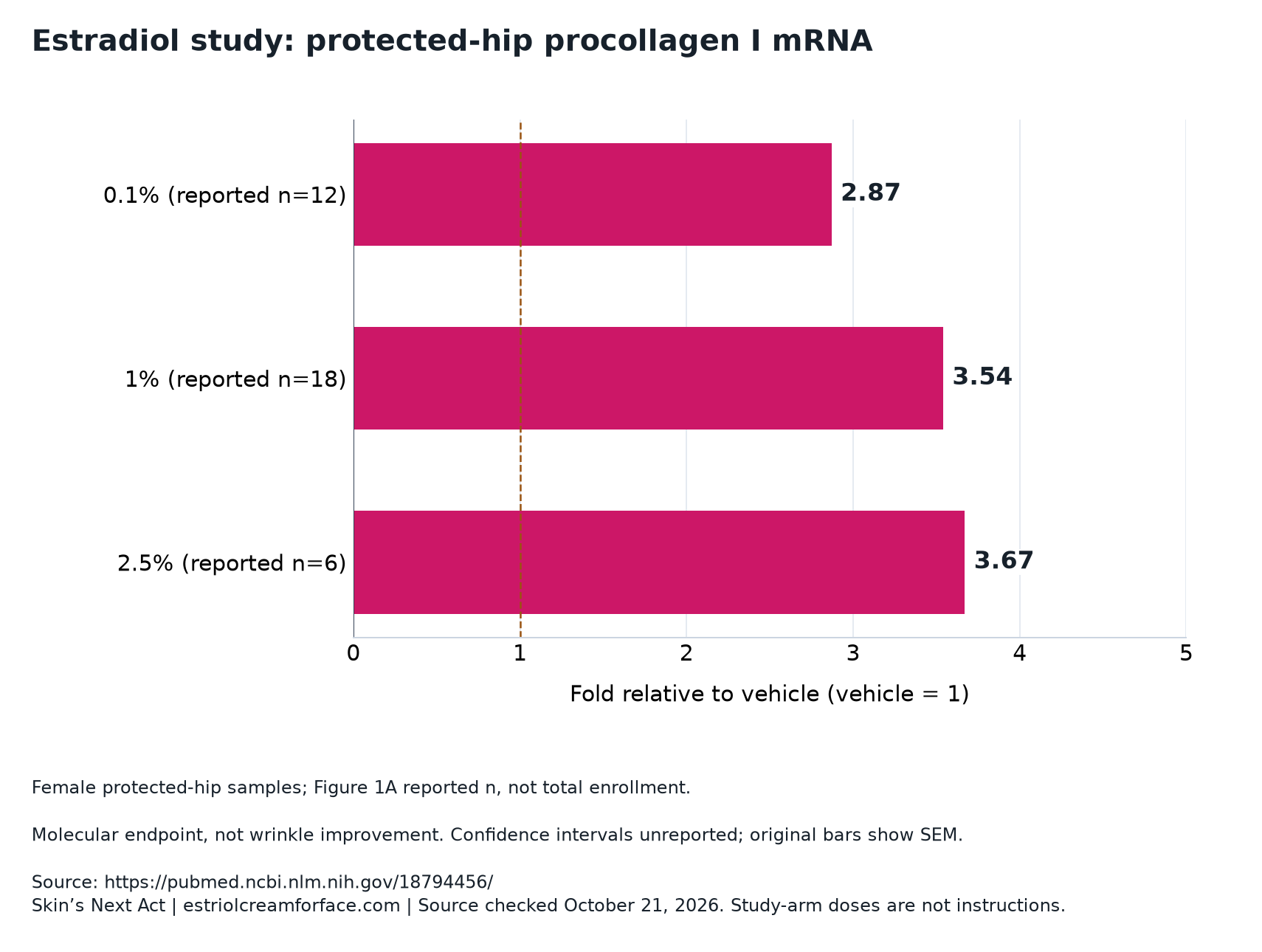
Estradiol study: protected-hip procollagen I mRNA
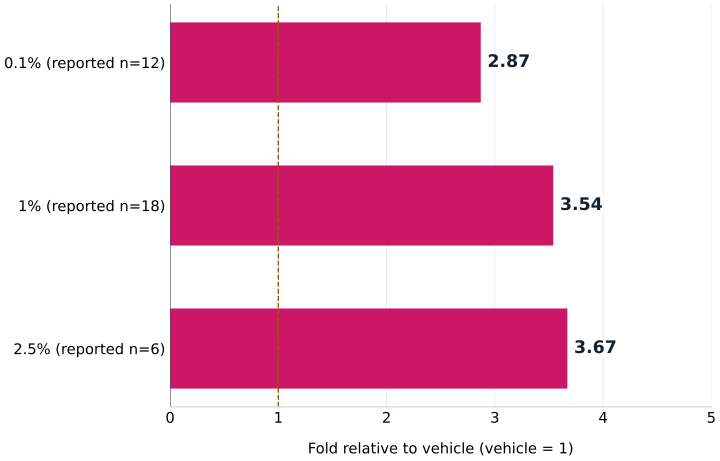
Female protected-hip samples; Figure 1A reported n, not total enrollment.
Molecular endpoint, not wrinkle improvement. Confidence intervals unreported; original bars show SEM.
Download chart (PNG)Download data (CSV)Download vector chart (SVG)
| Historical estradiol study concentration | Reported value |
|---|---|
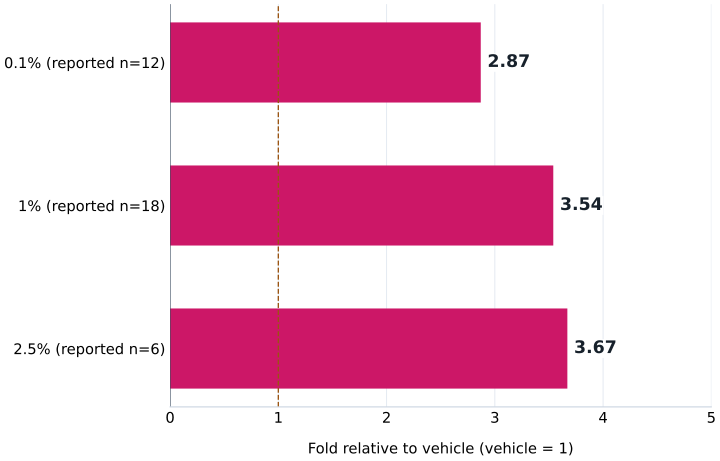
| 0.1% (reported n=12) | 2.87 |
| 1% (reported n=18) | 3.54 |
| 2.5% (reported n=6) | 3.67 |
Begin with the question each comparison can answer
Our first interpretive step is to write the question as a comparison rather than a benefit. Does a treated patch differ from its matched control? Does a later measurement differ from an earlier one? Does one anatomical site respond differently from another? Those sentences sound related, but the observations required to answer them are not interchangeable. Each defines a different quantity to estimate.
For a matched patch comparison, the useful unit is the difference within the person. That structure can reduce the influence of characteristics shared by both patches. It cannot remove a local difference that was already present between the patches, and it needs a credible explanation of treatment placement. A before/after comparison instead needs an account of what might have changed with time apart from treatment.
Reading the study map through these questions prevents its experiments from becoming one imaginary trial. Our practical rule is to keep a separate line for the intervention, comparator, site and measurement before considering the result. The guide to estriol as an estrogen helps establish ingredient language; the experimental comparison must then establish what that ingredient was actually being asked to demonstrate.
Follow the chain without skipping a measurement
Our interpretation separates four steps: a hormone-responsive signal, messenger RNA, protein and appearance. Messenger RNA is an instruction-bearing molecule; a measurement of its abundance does not itself count finished structural material. A protein measurement moves the question forward, but still needs a definition of what was measured and where. A visible endpoint requires its own observation rather than a renamed laboratory result.
Imagine an explicitly hypothetical experiment in which a signaling readout doubles while a structural readout stays near its reference. That pattern would justify investigating the connection between the readouts. It would not identify a single failed receptor, prove that all downstream responses are impossible or establish the duration needed for a different result. Several explanations could remain compatible with the same pair of measurements.
For the estradiol evidence, this framework keeps the strongest claim attached to the measurement that supports it. The valuable mechanistic question is not simply whether some response occurred. It is whether changing an upstream process also changed the downstream outcome of interest, under an appropriate comparison. A proposed connection remains a hypothesis until an experiment can distinguish it from competing accounts of the same observations.
Keep each participant attached to the denominator
A denominator tells a reader which observations support an estimate. It should not be treated as a decorative number beside a bar. Our reading rule is to ask whether it counts people, specimens, paired contrasts or repeated measurements. When a report does not settle that distinction consistently, the reader should retain the uncertainty instead of choosing the interpretation that makes the sample seem largest.
Consider a hypothetical laboratory exercise involving four people sampled at three visits. It produces twelve specimens, but it does not produce twelve independent people. If a persistent personal characteristic influences every specimen from one person, treating all specimens as unrelated can make the apparent precision misleading. The arithmetic of counting containers cannot settle the statistical question of how observations are related.
The same reasoning applies when combining dose experiments. Before pooling anything, an analyst would need to know who contributed to which comparison and whether measurements overlap. Our interpretation therefore treats the plotted sample labels as reported counts, not an invitation to reconstruct enrollment. Preserving an unresolved count is more informative than silently repairing it, because the unresolved detail affects which precision calculations a reader could legitimately attempt.
A fold change starts with its reference
A fold change is a ratio. Its meaning depends on what appears in the denominator, the measurement scale and how the comparison was assembled. Our hypothetical example begins with a laboratory reference of ten arbitrary units and a treated value of thirty. The ratio is three, and the absolute difference is twenty units. Neither number describes the percentage of people who would notice a visible change.
Now consider a second hypothetical assay with a reference of two units and a treated value of six. Its ratio is also three, although its absolute difference is four units. These invented examples show why a common fold value does not establish a common amount of material. They also explain why ratios from different assays should not be ranked as though they shared one ruler.
For a reader of the accompanying chart, our interpretation is to preserve its molecular unit and reference throughout the argument. A change of vocabulary to firmness, hydration or wrinkle reduction would require another measurement and a justified connection. The hydration and firmness guide develops that separation for clinical claims. The table below summarizes the hypothetical arithmetic, not the historical study results.
| Calculation | Invented example | Interpretation |
|---|---|---|
| Ratio | 30 ÷ 10 = 3 | Three times the reference reading |
| Absolute difference | 30 − 10 = 20 units | Depends on the assay scale |
| Relative increase | (30 − 10) ÷ 10 = 200% | Not a responder percentage |
| Second assay | 6 ÷ 2 = 3; 6 − 2 = 4 units | Same ratio, different absolute difference |
Uncertainty belongs to the estimate being compared
Standard deviation describes variation among observations; standard error describes estimated uncertainty in a mean under a statistical model. A confidence interval requires an additional calculation appropriate to that model. These terms should not be exchanged merely because all can appear beside a number. Our interpretive rule is to identify both the quantity being estimated and the procedure used to describe its uncertainty.
In a hypothetical independent sample of sixteen observations with a standard deviation of eight arbitrary units, the usual standard error of the mean is eight divided by the square root of sixteen, or two units. This is an instructional calculation, not an estimate from the skin study. It does not provide the uncertainty of a paired treatment contrast, which depends on the variation in the within-person differences.
A further trap appears when one comparison passes a significance threshold and another does not. Those two decisions do not themselves test whether the comparisons differ. The relevant analysis needs the difference between the estimates and its uncertainty. Our reading of a molecular experiment consequently keeps three questions separate: the estimated response, its precision and the direct evidence for a difference between conditions.
Test the difference before explaining its cause
Our interpretation of a site comparison begins with a question about evidence for a difference, before proposing its biological cause. Anatomical location, prior exposure, local tissue characteristics and experimental conditions can be intertwined. A useful causal experiment would need a way to separate competing explanations. Naming photoaging as a plausible explanation does not by itself establish that it produced the entire observed pattern.
Imagine a new, explicitly hypothetical study with matched controls at both locations. At one location, treated and control measurements change by eight and three arbitrary units; at the other, they change by five and two. The treatment contrasts are five and three, and their difference is two units. Testing that last difference would address the site question; comparing two separate significance labels would not.
This proposed calculation is not a reconstruction of the historical facial experiment. It illustrates the comparison a future design would need. Connecting that comparison to appearance would require another endpoint with consistent observation conditions. The before-and-after photograph guide explains why visual documentation also needs a defined comparison. A persuasive explanation should survive an alternative account, rather than merely sound compatible with one set of findings.
| Question | Comparison needed | Inference still separate |
|---|---|---|
| Does location modify response? | Direct difference between controlled site effects | Which local feature causes the difference |
| Does a signal predict structure? | Linked measurements within an explicit model | Whether the structural change is visible |
| Does appearance improve? | Prespecified clinical endpoint and comparator | Whether benefit persists |
| Does exposure create harm? | Exposure measurements plus appropriate safety follow-up | Risk in populations not studied |
A blood measurement answers an exposure question
An exposure measurement and a safety outcome serve different purposes. Our interpretation begins by asking what was measured, when it was sampled and which comparison was used. A relative increase requires a starting value to convey its absolute scale. An absence of a statistically detected difference instead raises questions about precision and what size of difference the design could have detected.
The indexed 1993 abstract describes seventeen women using facial estradiol or estriol ointment for three months, without significant serum-hormone or vaginal-smear changes. It does not establish randomization or a vehicle comparator. That report supplies another observation to examine, not a reason to erase an exposure finding from a different experiment. A common ingredient category does not make the observation schedules or comparisons equivalent.
Our proposed assessment would place formulation, concentration, sampling time and population beside each exposure estimate before attempting reconciliation. A focused hormonal measurement cannot stand in for observing every clinically important event. Conversely, a measured change in a blood concentration does not by itself specify the probability of a particular harm. Those are distinct research questions, requiring a chain of evidence rather than a single reassuring or alarming adjective.
Compare endpoints before comparing conclusions
The 2026 P-124 conference abstract describes ninety women aged fifty to sixty, randomized to estriol, estradiol or placebo cream for twelve weeks. Its table shows no significant fine-line or wrinkle comparisons; participant-rated efficacy also lacked between-group differences. Alloy Health funded the study. Our analysis of the facial pilot examines its rating scales, table and reporting limits in detail.
The indexed 1996 abstract instead reports fifty-nine women receiving two active estrogen preparations for six months, with biopsies in ten; a vehicle comparator and randomization are not established. These descriptions do not create one cumulative experiment. Our interpretation is that a comparison becomes scientifically useful only after its ingredient, population, outcome and reference are aligned. More publications cannot compensate for a mismatch in the question being answered.
For example, a future trial could improve an observer rating without demonstrating a molecular mechanism, while a laboratory experiment could support a mechanism without establishing a noticeable benefit. Those possibilities are not logical contradictions. To call one study a replication, a reader needs a specified finding that the new design actually retests. To call it a contradiction, the apparent disagreement must remain after differences in measurement and comparison are considered.
Follow the preparation from experiment to product record
A formulation comparison should begin with identity, not a familiar ingredient name. Our documentary checklist asks which estrogen was present, which concentration was specified, what carried it and which preparation was actually evaluated. It then asks whether the evidence being discussed belongs to that preparation. A shared noun on two labels cannot supply the missing link between a laboratory material and a commercial product.
FDA reports no approved estriol-containing drug. Compounded medicines lack FDA approval and are not approved generics. Those regulatory facts answer an approval question; they do not supply an effect estimate for an individual preparation. The guide to compounding records provides a framework for checking the documentary details separately from the biological argument. Scientific plausibility and a product’s regulatory category should remain identifiable parts of the assessment.
For examples of the records a reader might inspect, the Time Out review and Midi product-record review are starting points. These links do not identify either product as the historical intervention. Our interpretive recommendation is to record an unanswered identity question explicitly rather than bridge it with an assumed equivalence. A documentary gap is a gap in the evidence, not an invitation to invent a preparation’s results.
Specify the experiment that would move the argument forward
The next study could place a clearly stated clinical claim before mechanistic measurements. A protocol could name one appearance endpoint, define a meaningful difference in advance and explain how molecular observations will test a proposed connection. Repeated measurements would need an analysis that accounts for their relationship within each participant.
A convincing report would make treatment allocation, comparator selection, assessment masking, missing observations and follow-up transparent. It would identify which analyses were planned, how several endpoints were handled and whether the sample supported the intended precision. These details matter because an apparently coherent biological story can emerge after investigators have seen many different measurements. A prespecified question makes the strength of that story easier to judge.
Funding disclosures belong beside this design assessment. They help readers recognize relationships and ask about independent confirmation, but they neither invalidate an estimate automatically nor validate it through disclosure alone. Our interpretation therefore asks the same concrete questions of every study: what observation would change the conclusion, who could reproduce the comparison and which remaining uncertainty requires a different experiment? Those questions offer a clearer path forward than treating one molecular response as the end of the inquiry.
Questions about the evidence
Does a stronger molecular signal imply a larger visible effect?
No necessary proportional relationship follows from that description. Our interpretation would require a study linking changes in the molecular measurement to changes in a defined visible endpoint. A signal could be one contributor among several, and a larger reading could occur without a correspondingly larger clinical change. A proposed mechanism becomes more useful when it generates a testable prediction about the outcome that matters.
Can the concentration printed on a label identify the preparation studied?
Concentration identifies only one part of a preparation. Our documentary approach also checks the ingredient’s identity, the formulation, the evaluated batch or product description and the experimental conditions. Matching one number cannot establish that all other relevant features match. When the original description is incomplete, the appropriate conclusion is that equivalence has not been demonstrated, rather than that the two preparations must differ or must perform alike.
How should a reader handle a disagreement between a table and a figure?
Keep the conflicting information visible and restrict conclusions to what remains clear. Our approach avoids selecting the version that produces the tidiest story or using an uncertain count to calculate a new precision estimate. A correction, detailed methods record or author clarification could resolve the disagreement. Until then, an unresolved detail should narrow the analysis without erasing independently interpretable observations.
Would longer follow-up automatically resolve the uncertainty?
Additional time could answer a duration question, but it does not automatically repair an unsuitable comparator or a mismatch between outcome and claim. Our interpretation would first specify what a later observation is expected to distinguish. Durability, delayed response and uncommon harm are separate questions. Each needs an appropriate measurement schedule, sample and analysis rather than an assumption that waiting longer settles them all.
What role should photographs play alongside laboratory measurements?
Photographs can document an appearance endpoint when acquisition and assessment are planned consistently. Our proposed use would define lighting, expression, positioning, image selection and assessment before comparing results. An image should then answer its stated visual question. It should not be used to infer an unmeasured hormone concentration, identify a molecular mechanism or convert a laboratory ratio into a visible percentage improvement.
Editorial assessment
Our assessment is to treat the evidence as a sequence of questions with different measurements, not a single claim that grows stronger every time the word collagen appears. The useful result is a map of what each comparison can support and which additional observation would change the interpretation. A reader should be able to locate the ingredient, comparator, denominator and endpoint behind a statement, then identify the untested step before applying it to appearance or a commercial preparation. That discipline preserves the scientific value of a mechanistic experiment while keeping a clinical promise dependent on clinical evidence.
Research access and limitations
Participant counts conflict (17 versus 18); protein-dose labels disagree. Error bars show SEM, not confidence intervals. The 1993 and 1996 comparisons use indexed primary abstracts; the 2026 comparison uses a conference abstract and table. Historical research concentrations identify experiments and are not instructions for use.
Sources and access notes
Sources checked October 21, 2026. Access notes identify the material examined for this article.
- Induction of collagen by estradiol: difference between sun-protected and photodamaged human skin in vivo. ↗Primary full article: methods, main results, participant table, figure captions, discussion and funding reviewed on publisher site · Checked October 21, 2026Source-register context →
- When applied to facial skin, does estrogen ointment have systemic effects? ↗Indexed primary study abstract · Checked October 21, 2026Source-register context →
- Menopause Society 2026 abstract P-124: pilot study of estriol or estradiol facial cream ↗Original 2026 conference abstract P-124 and its complete table, PDF page50; text and rendered page reviewed · Checked October 21, 2026Source-register context →
- Treatment of skin aging with topical estrogens. ↗Indexed primary study abstract · Checked October 21, 2026Source-register context →
- FDA Office of Women’s Health: menopause and estriol approval questions ↗Official FDA consumer page read directly; brief regulatory summary retained · Checked October 21, 2026Source-register context →
- FDA: Compounding and the FDA—questions and answers ↗Official FDA questions-and-answers page read directly; concise editorial summary retained · Checked October 21, 2026Source-register context →